News Summary
The East Wing of the White House is undergoing demolition to make way for a $300 million ballroom project ordered by President Trump. This ambitious renovation has sparked political outrage from Democrats, who criticize the timing amid pressing national issues. Supporters argue it addresses the need for larger event space. As funding claims suggest no taxpayer money will be used, the project raises questions about priorities and the preservation of historical significance. The East Wing has served as a vital space for first ladies, making the demolition a contentious issue in a politically charged atmosphere.
Controversial Renovation: The Demolition of the East Wing for Trump’s Grand $300 Million Ballroom Project Sparks Political Outrage
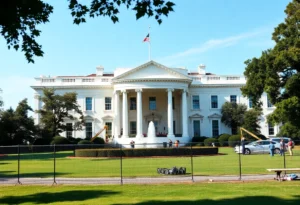
In a move that has the nation buzzing, the East Wing of the White House is currently undergoing demolition to pave the way for a proposed 90,000-square-foot ballroom, a project ordered by President Donald Trump and estimated to cost around $300 million. This ambitious renovation has ignited fierce debate, drawing sharp divisions along party lines, leaving many citizens wondering about the true intentions behind such a massive undertaking.
As the demolition progresses, Democrats are expressing their outrage, declaring this to be a classic example of the administration’s seeming disconnect with the pressing issues facing the American public, particularly with ongoing concerns related to government shutdowns. Meanwhile, Republican leaders are applauding the plan, citing it as part of a long-standing tradition of White House renovations. Historical precedents, which include the addition of FDR’s swimming pool, Obama’s basketball court, and Thoft’s Oval Office improvements, are frequently mentioned in defense of the current project.
The Argument Over Necessity and Priorities
Trump has justified his decision by claiming the East Room is too small for large events, necessitating a bigger space to showcase grand gatherings. Supporters of the ballroom project argue that it fulfills a critical need for hosting significant functions, while critics view it as an unnecessary destruction of a historically important structure. The White House claims that the ballroom will be completed well before Trump’s term ends in January 2029, showcasing an ambitious timeline that aims to demonstrate progress and dedication.
Republican Speaker Mike Johnson describes the planned ballroom as the epitome of glory, emphasizing the positive aspects of the renovation. On the contrary, opposition figures like Democratic Senate Leader Chuck Schumer suggest that the focus should remain on immediate concerns rather than a lavish new ballroom. Senator John Kennedy from Louisiana, who is unconcerned with architectural significance, reflects a general sentiment among some Republican lawmakers who prioritize functionality over aesthetics.
Public Funding and Private Contributions
In a surprising twist, Trump has mentioned that he and his supporters will finance the construction without dipping into taxpayer money, aiming to quell some of the discontent surrounding the project’s financing. Legislators like Senator Markwayne Mullin have stepped forward to defend the renovation by reassuring the public that funding will come from private sources, further confusing many who feel this is a vocalization of priorities that are misaligned with current national issues.
The Treasured Legacy of the East Wing
Established in 1942 to accommodate additional staff and offices, the East Wing holds a wealth of historical significance. It has served as a launching pad for first ladies who have used the space to champion causes and forge initiatives that have positively impacted the community, such as advocacy programs and literacy drives.
Critics of the demolition argue it represents an irreversible alteration of history, one that cannot be undone, unlike previous renovations that were less dramatic in scope. The East Wing has become a symbol of the evolving role of the first lady, intertwining the political, social, and historical narrative of the White House, making its loss all the more troubling to some.
Former chief of staff to Laura Bush, Anita McBride, acknowledges the ballroom’s necessity for large entertaining events, yet others, including Krish O’Mara Vignarajah, see the demolition as a symbolic blow to the legacy of the East Wing. As images of the demolition circulate, Democratic lawmakers have been quick to utilize them during speeches to underline their concerns regarding the direction Trump is taking the nation.
The Bigger Picture
In conclusion, as the East Wing is dismantled to make way for a seemingly extravagant ballroom, the nation is left to grapple with the complex layers of history, tradition, and politics. Will this renovation stand as a testament to progress or a reminder of what was lost? Time will tell as conversations surrounding the role of the first lady and the historical spaces of the White House continue to evolve. The heart of America beats strong through its history, and every alteration raises questions about its future.
Deeper Dive: News & Info About This Topic
Black Pearl Restaurant Expands in Ann Arbor
Monty’s Public House Revitalizes Ann Arbor’s Community Space
Community Unites to Support Foster Care on Legacy Day
Renovation Breathes New Life into Metamora’s White Horse Inn
Dearborn Inn Reopens After Major Renovation to Blend Heritage and Comfort
Transform Your Bathroom with 2025 Tile Trends
Michigan Wolverines Propose $300 Million Ice Arena Renovation
Additional Resources
- The Washington Post: Ballroom East Wing Trump White House
- The Washington Post: Historic Magnolia Trees Removed
- The Wall Street Journal: Trump White House Ballroom Construction
- NBC Washington: East Wing White House Gone History Made
- Reuters: Bulldozer Ballroom Trump Makes His Mark
- Wikipedia: White House
- Google Search: Trump White House East Wing
- Google Scholar: White House Renovation
- Google News: White House East Wing Demolition